•no comments

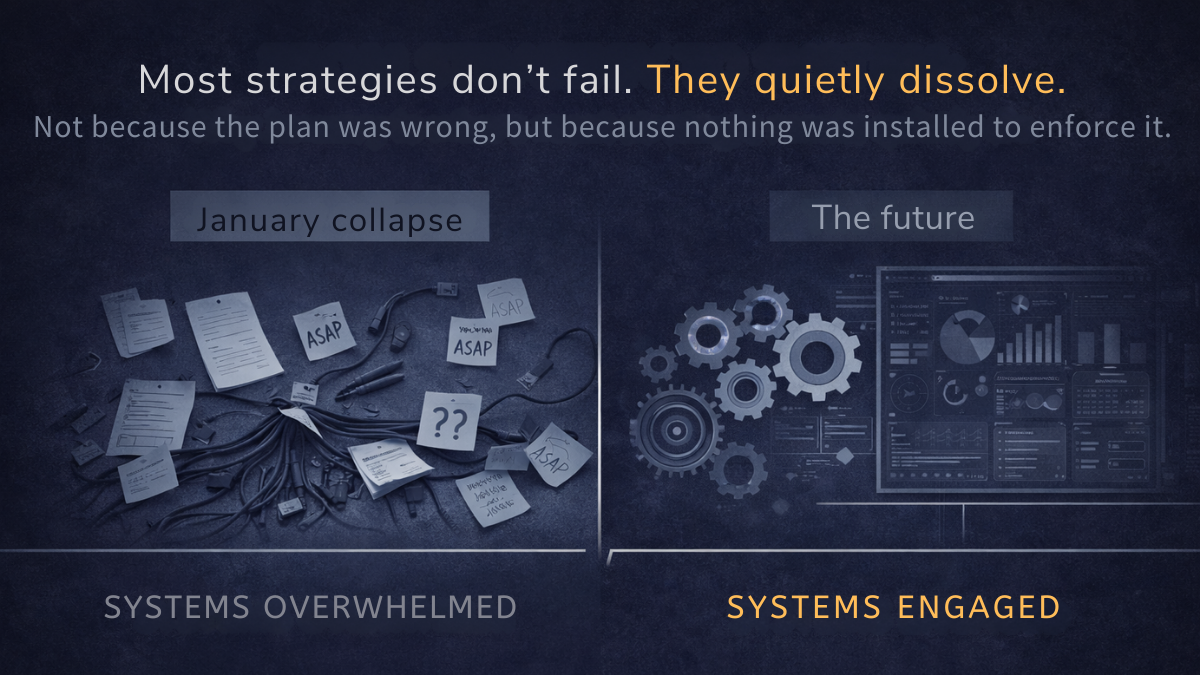
Most companies don’t fail at strategy.
They fail at installing it.
December creates clarity. Leadership teams step back, diagnose constraints, and articulate bold intentions. Then January arrives — and almost all of that progress evaporates. Not because the strategy was wrong, but because nothing structural actually changed.
At Power Partners, we see this pattern across industries, ownership structures, and company sizes. Strategy gets declared. Systems stay the same. Results follow the system — not the strategy.
January doesn’t test ambition. It tests whether intent crossed into operating design.
January feels productive. Calendars fill up. Dashboards refresh. Leadership meetings regain energy. And yet, execution quietly reverts by mid-month.
That reversion isn’t a failure of will. It’s a failure of mechanics.
Forbes has repeatedly pointed out that execution — not planning — is the dominant differentiator between high-performing companies and the rest. Strategy without operational enforcement fails inside otherwise capable organizations. January exposes whether a company redesigned how it operates, or merely talked about doing so.
The illusion is subtle. Activity feels like progress. Meetings feel like control. Metrics feel like governance.
They aren’t.
Control exists only when certain outcomes are structurally impossible. When capital deployment is constrained by design. When cash leakage triggers consequences automatically. When KPIs are enforced by the system, not reviewed by committees.
Bloomberg regularly highlights companies that report strong performance while remaining operationally fragile because discipline depends on vigilance instead of structure. Vigilance fails. Systems don’t.
If your January execution still relies on leaders “paying attention,” your reset is already unstable.
A December strategic reset should have already clarified the real constraint and the correct structural solution. January’s role is non-negotiable: hard-code those insights into the operating system.
That means decision rights are explicitly redefined. Approval thresholds are adjusted or eliminated. Pricing authority is governed, not improvised. Hiring, spend, and growth are tied to cash capacity. Automation enforces rules rather than reporting violations after the fact.
Harvard Business Review has long reinforced that execution improves dramatically when decision authority and accountability are engineered into the system instead of left to managerial discretion.
January reveals whether this work happened.
If the reset was real, leadership should be able to answer uncomfortable questions without hesitation.
If the answer is “we’re watching it more closely,” nothing changed. You renamed the same operating model.
January isn’t about motivation. It’s about locking the system before entropy re-enters.
High-performing companies don’t rely on discipline. They rely on design. Strategy that requires constant vigilance to execute is already broken.
If your strategy still depends on memory, meetings, heroics, or leadership bandwidth, it will collapse under pressure.
The companies that win January don’t try harder.
They remove failure paths.